NUMBER SLIDE · GAMESHUSH
Why move a tile that is already correct?
The 8 is already in the right place. Leave it alone—that seems like a sensible rule. But look at this 3×3 board before adopting it:
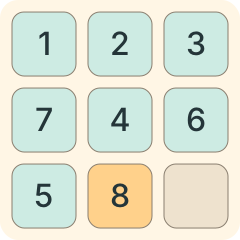
The top row is finished. So is the 6, and the 8 is in its target square. The remaining work is in the lower-left corner. Yet the blank is at the lower right: before it can help those tiles, it needs a way to reach them.
Try the next move in your head
The blank has two neighboring tiles, 6 and 8. Both are correctly placed. If your rule is never to move a correct tile, you have no permitted move at all—even though the puzzle is solvable. Correct placement is useful information, but it cannot be an absolute prohibition.
Follow six slides
The sequence below names the TILE to move into the blank, not the direction of the blank: 8, 5, 7, 4, 5, 8. Each move uses a direct neighbor. Here is the entire path:
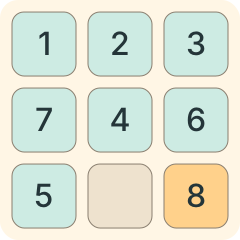
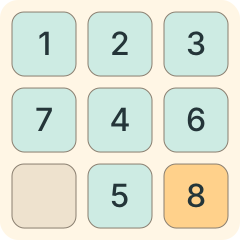
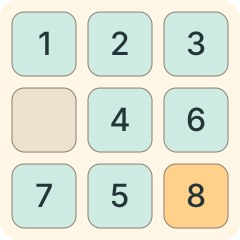
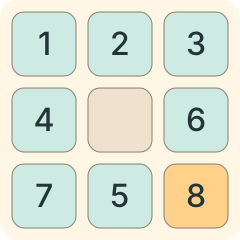
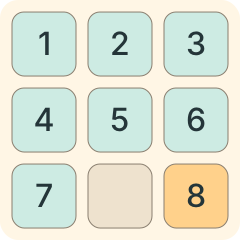
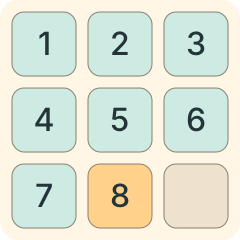
The first slide displaces the 8. The next two bring the blank to the left side and put 7 into its target square. Moving 4 left opens the center for 5. Finally, 8 returns to the square it occupied at the beginning. The top row and 6 never need to move along this route.
Why four squares of distance take six moves
Count each numbered tile's horizontal and vertical distance from its target, ignoring the blank. Tile 4 needs one step left. Tile 7 needs one step down. Tile 5 needs one step right and one step up. All other numbered tiles have distance zero. The total is four.
This total is a lower bound: one legal slide moves one tile by one square, so it cannot reduce the total by more than one. But the bound does not include the work of getting the blank to a useful location. In our route, 8 takes one step away from its target and one step back. Those two extra slides make the four useful advances possible.
Could a different route solve it in fewer than six moves? For this specific board, no. An exhaustive breadth-first search through legal 3×3 positions finds the first solution at six moves. That establishes a shortest route for this example; it does not say a larger puzzle can always be solved by this sequence or that the game provides a shortest-path hint.
What to notice in your next puzzle
When a move looks like a step backward, inspect what access it creates. Which tile can move next? Where will the blank end up? Can the displaced tile return after the other tiles have advanced? Those questions are more useful than treating each correctly placed tile as untouchable.
Do not turn this into the opposite rule and disturb finished sections without a purpose. Here, moving 8 is justified by a complete short route. In a larger board, improvising a detour can undo earlier work. Try to name the small region you are rearranging and the opening you need before sliding.
This is a teaching position, not a promised starting board in Number Slide. It uses the game’s adjacent-slide rule.
Read the Number Slide guide or try the browser game. All blog articles.