SUDOKU · GAME NOTES
Why 63 clues can still leave two answers
A Sudoku can look almost finished and still fail to have one answer. Here is a concrete example: keep 63 of the 81 cells filled, but remove every 1 and every 2.
Try the swap
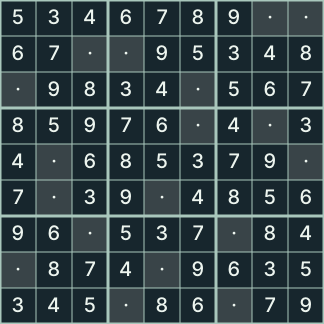
One valid completed first row is 5 3 4 · 6 7 8 · 9 1 2, where the separators divide the boxes. Now swap every 1 and 2 throughout the entire completed grid. Its first row becomes 5 3 4 · 6 7 8 · 9 2 1.
Both completions obey the row, column and box rules. Neither changes a visible clue, because none of the clues is a 1 or 2. So this 63-clue board has at least two answers. Checking both completions with the game’s Sudoku rules confirms it. The solution counter also finds more than one answer; it stops once it has found two.
What GamesHush checks before giving you a puzzle
The browser game starts from a complete valid grid, rearranges rows and columns within the allowed groups, and shuffles the digits. It then tries removing clues in a shuffled order. A removal stays only when the remaining board is confirmed to have exactly one solution. If the check finds multiple answers, or cannot finish within its search budget, that clue is restored.
That last distinction matters. “The search did not finish” does not mean “there is one solution.” A bounded check must treat uncertainty conservatively rather than hand an ambiguous board to the player.
Difficulty is another question
A unique answer tells you that the puzzle is well-defined. It does not tell you how easy the deductions will be. GamesHush separately checks solving techniques: Easy stays with singles; Medium can use locked candidates and naked pairs; Hard can require deeper search. A Medium or Hard board can still turn out to be solvable with singles.
The generator aims for 42, 34 or 28 starting clues for Easy, Medium or Hard respectively. It may retain more clues when removing another would fail its checks. Those targets are part of this implementation, not universal difficulty rules.
A better way to choose your next puzzle
Choose a level based on the reasoning you want to practise. If you are learning to scan for one possible digit, start with Easy. When you want to practise candidate elimination, try Medium and look at the technique label rather than assuming every board will demand a pair.
Do not interpret a clue-heavy puzzle as badly made, or a sparse one as automatically better. The useful questions are whether the answer is unique and whether the deductions suit the session you want.